
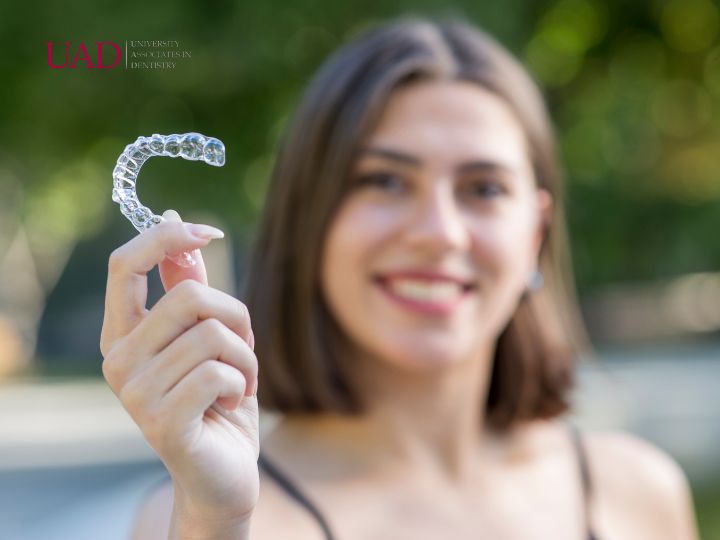
You noticed it in a photo from a friend’s wedding, or on a video call where your own face sat in the corner of the screen. Your bottom front teeth have crowded up since college. Or the space between your top two teeth has opened a little wider than it used to be.
Most adults who ask us about this are a candidate for Invisalign. Some are better served by a different approach, and you will hear which one you are at the first visit. Dr. Lauren Zalay has been treating Invisalign cases at UAD for years and is recognized as a Top Doctor for the treatment. Here is what clear aligners move well, what they leave alone, and how we tell the difference.
What Invisalign is doing while you wear it
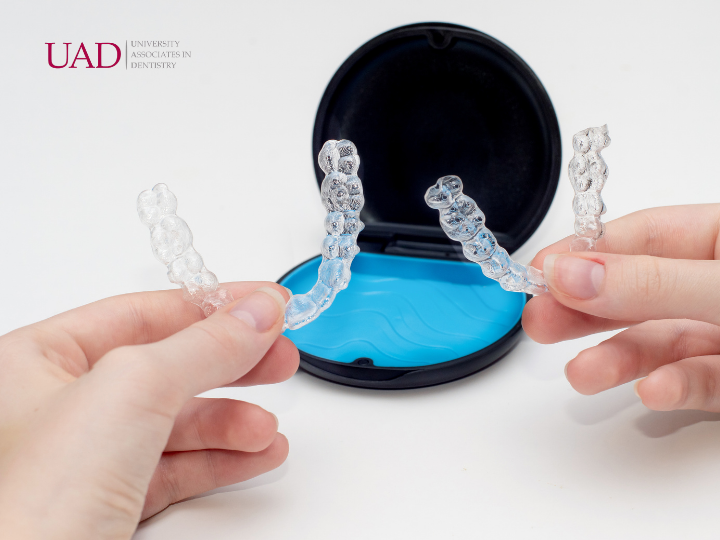
Invisalign is a set of clear plastic trays. Each one is shaped to your teeth in a position slightly ahead of where they sit now. You wear a tray, your teeth follow it, and you move to the next one in the series.
The American Association of Orthodontists puts wear time at 20 to 22 hours a day for most cases. The trays come out when you eat, when you drink anything other than water, and when you brush. Everything else, including your workday and your meetings, happens when wearing them. Nobody across the table will notice.
Wear time is the one part of this you control, and it is the part that keeps your finish looking like the plan you approved. Patients who keep the trays in through the day tend to land on schedule.
The cases clear aligners handle well
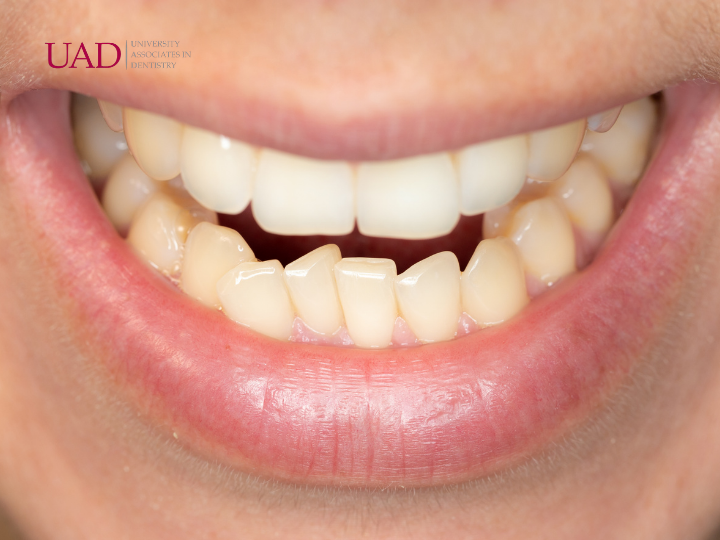
Crowding that came back after childhood braces
This is the most common Invisalign case we see in adults. Teeth shift over the years, particularly the lower front ones, and a retainer that went missing in a college dorm sped it along. These cases are often short, because the teeth are moving back to a position they already held once.
Gaps and spacing
Aligners close small spaces predictably, whether that is one gap between the front teeth or several narrow ones along the arch.
Teeth that drifted after you lost one
When a tooth comes out, the neighbors lean toward the opening. Straightening those teeth first gives a dental implant the room it needs to sit where the original tooth was. Having the surgical and restorative doctors in the same office as Dr. Zalay keeps that sequence simple.
Alignment before veneers or crowns
f your teeth are crowded and you want a cosmetic result, moving them into position first means less tooth structure has to be removed later. Our prosthodontist, Dr. Schelkopf, handles the porcelain side of cosmetic cases, and a few months of aligners beforehand often means a more natural finish with less of your own tooth removed.
Some bite corrections
Mild overbites, crossbites, and open bites respond to aligners, often with small tooth-colored attachments or elastics added. Mild is the key word there. Bigger bite differences are worth a longer conversation, which is the next section.
What Invisalign® will not fix on its own
Aligners move teeth. Color, tooth shape, jaw position, and a handful of specific movements sit outside that job.
Color, chips, and tooth shape
Straightening a tooth does not change what shade it is or repair a worn edge. Plenty of patients finish aligners and then whiten, bond, or move on to veneers or crowns. The order matters, and straightening first usually makes the cosmetic part easier.
Bite differences that come from the jaw
Some bites are a matter of how the upper and lower jaws are sized and positioned relative to each other. Aligners move teeth within the jaw and do not reposition the jaw itself. Cases like these belong with an orthodontist and we will tell you that at the consultation.
Certain movements that trays struggle to produce
Rotating a round tooth like a canine, pulling a tooth down into the arch, or uprighting a molar are movements aligners perform less predictably than braces. Attachments help. There is still a point past which braces are the better tool. We do not do braces here, so a recommendation for braces sends you somewhere else. You will get it anyway if that is what your case needs.
Anything sitting on top of untreated decay or gum disease
Teeth move through bone, so the foundation gets handled first. This is usually a short detour, not a closed door.
How we tell if you are a candidate for Invisalign®
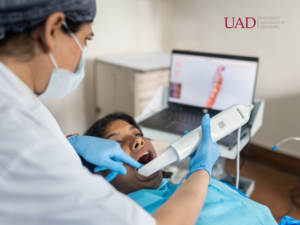
The consultation is complimentary and it takes one visit.
Dr. Zalay examines your teeth and gums, then scans your mouth digitally. No trays of putty. From that scan, you see a digital rendering of where your teeth would finish, so you can decide whether the result is worth the months of wearing trays before you commit to anything. You will also get a treatment time estimate for your case, what it costs, and how financing works if you want to spread it out.
If the scan shows that aligners will handle it, you can start. If your case would finish better with braces or with an orthodontic specialist, you will hear that in the same visit. More patients than we can count have told us this is why they stayed with UAD. We tell you what you need, and we tell you what you do not.
Fitting Invisalign® into a downtown Chicago schedule

Frequently Asked Questions: Are You a Candidate for Invisalign®?
Am I too old to be a candidate for Invisalign?
No. Teeth move at any age as long as the bone and gums supporting them are healthy. We treat patients well into their sixties and beyond. Adults who had braces as teenagers are among the most straightforward cases we see.
How long does Invisalign take?
Most adult cases run somewhere between six and eighteen months, depending on how far the teeth need to travel. Minor crowding that relapsed after braces sits at the shorter end. You get an estimate for your own case at the consultation, based on your scan rather than an average.
What does Invisalign cost in Chicago, and will insurance help?
Cost depends on the number of aligners your case needs and whether other treatment is involved. Many dental plans with orthodontic coverage treat clear aligners and traditional braces the same way. We will discuss your payment and financing options when you come in.
Will anyone be able to tell I am wearing them?
Rarely. The trays are clear and thin. A few patients notice a slight lisp for the first day or two while their tongue adjusts, and it settles.
Do I have to wear a retainer afterward?
Yes, and this is the part worth taking seriously. Teeth drift back toward where they started if nothing holds them. A retainer at night protects the result you paid for, which is exactly what went missing the first time around for most of our adult patients.
Can I straighten just my bottom teeth?
Sometimes. It depends on how your bite comes together. Dr. Zalay can tell you after the scan whether treating one arch will hold up over time.
Find Out in One Visit
If you have been wondering whether you are a candidate for Invisalign, a scan and a conversation will answer it. The consultation is complimentary, and you will leave knowing what your teeth would look like, what it would take, and what it would cost.
Schedule your complimentary consultation at 222 N. LaSalle in the Loop, or call (312) 704-5511.